


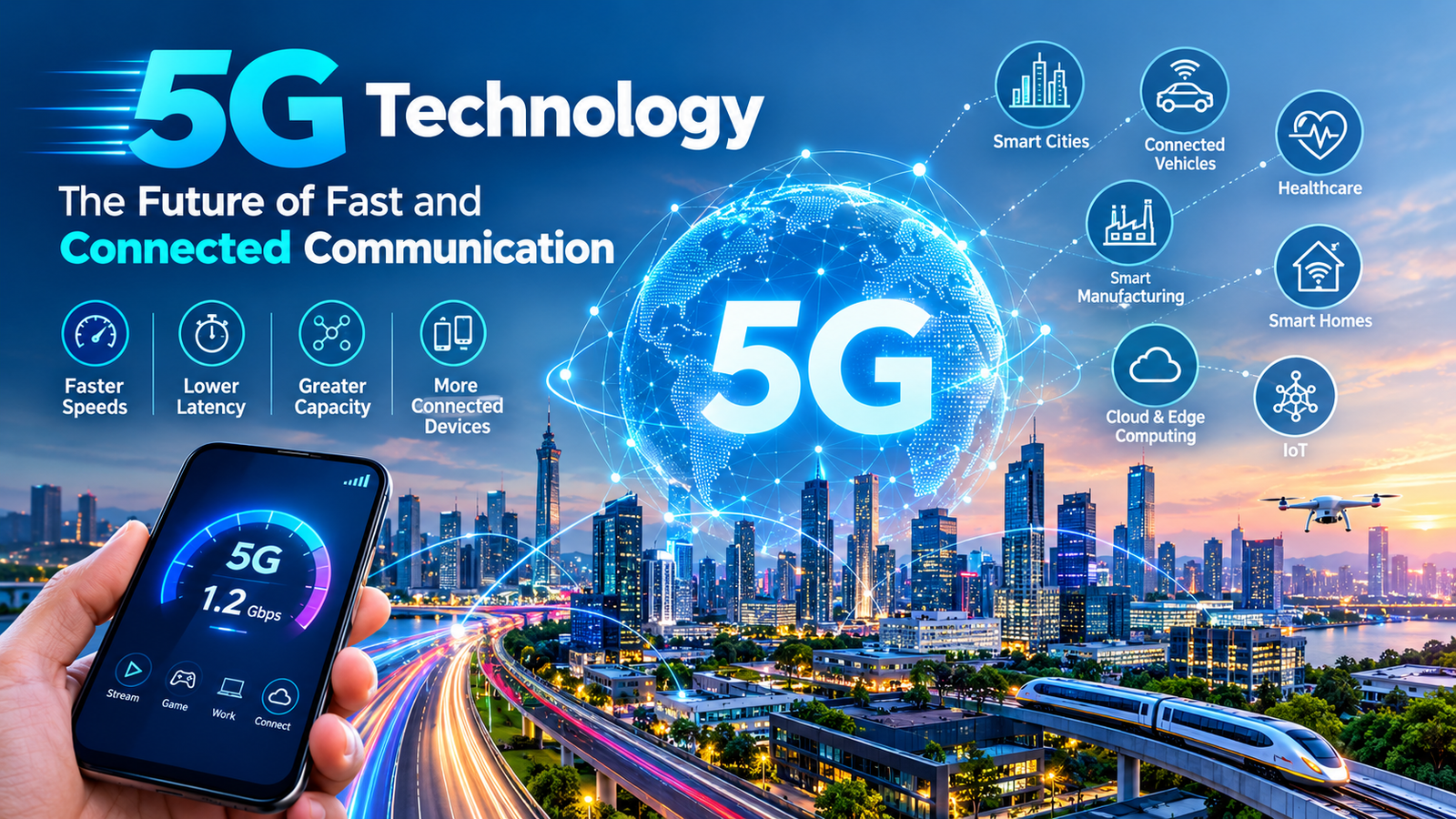
5G Technology has become one of the most important developments in modern telecommunications. Designed to provide faster speeds, lower latency, greater network capacity, and more reliable connections, 5G is changing the way people use mobile devices and digital services. From smartphones and streaming to smart cities, connected vehicles, healthcare, manufacturing, and the Internet of Things, 5G technology is creating new possibilities for communication and connectivity.
As digital demand continues to grow in 2026, reliable and high-speed connectivity has become more important than ever. Businesses need faster networks to support cloud applications and connected devices, while consumers expect smooth video streaming, online gaming, video calls, and other real-time services. 5G technology is designed to support these growing requirements while providing a foundation for future digital innovation.
What Is 5G Technology?
5G stands for the fifth generation of mobile network technology. It is the successor to 4G LTE and is designed to improve wireless communication through higher data speeds, lower latency, increased network capacity, and improved reliability.
Unlike earlier generations that primarily focused on improving mobile internet access, 5G technology is designed for a much broader range of applications. It can connect smartphones, industrial machines, vehicles, sensors, smart home devices, and other connected systems.
The exact performance of a 5G network depends on factors such as spectrum, network design, coverage, device capabilities, and network congestion. Therefore, users may experience different speeds and performance depending on their location and service provider.
How Does 5G Technology Work?
5G technology uses advanced wireless communication techniques and a wider range of radio frequencies to deliver data between devices and network infrastructure.
One important part of 5G is the use of different spectrum bands. Low-band 5G can provide broader coverage and better building penetration, while mid-band 5G can provide a balance between coverage and speed. High-band or millimeter-wave 5G can offer very high speeds over shorter distances but generally requires more network infrastructure.
5G networks can also use technologies such as massive MIMO, beamforming, and network virtualization. These technologies help networks manage large numbers of devices and direct wireless signals more efficiently.
Another important feature is network slicing. It allows operators to create logical network segments designed for different requirements. For example, one segment could support high-speed consumer services while another could be configured for applications that require high reliability.
Key Features of 5G Technology
5G technology introduces several improvements compared with previous generations of mobile networks.
Faster Internet Speeds
One of the most widely discussed benefits of 5G is faster data transfer. Depending on the network and spectrum being used, 5G can provide substantially higher speeds than many 4G connections.
Faster speeds make activities such as downloading large files, streaming high-quality video, using cloud applications, and transferring data more convenient.
Lower Latency
Latency refers to the time it takes for data to travel between a device and a server or network destination. 5G is designed to reduce latency compared with previous mobile technologies.
Lower latency can be valuable for applications that require quick responses, including interactive gaming, industrial automation, remote monitoring, and certain real-time communication systems.
Higher Network Capacity
Modern networks need to support millions of connected devices. 5G technology is designed to handle a much larger number of connections in busy environments.
This can be particularly useful in stadiums, airports, shopping centers, urban areas, factories, and other locations where many devices are connected simultaneously.
Improved Reliability
5G networks can be designed to provide highly reliable communication for applications that require consistent connectivity. Reliability is particularly important for industrial systems, connected infrastructure, and other professional applications.
Better Support for IoT
The Internet of Things, or IoT, includes connected devices such as sensors, smart appliances, industrial equipment, security systems, and monitoring devices.
5G technology can help support large-scale IoT deployments by providing connectivity for many devices and enabling organizations to collect and process data more efficiently.
5G Technology and Smartphones
Smartphones are one of the most visible applications of 5G technology. A compatible smartphone connected to a suitable 5G network can provide faster mobile internet and improved performance in supported areas.
Users can benefit from quicker downloads, smoother high-resolution streaming, faster cloud services, and responsive online applications. However, having a 5G smartphone does not automatically guarantee maximum 5G performance. The actual experience depends on network coverage, spectrum, device support, signal conditions, and the mobile plan.
As 5G coverage expands, more smartphones are expected to support the technology, making high-speed mobile connectivity increasingly common.
5G and Smart Cities
Smart cities use connected technologies to improve transportation, energy management, public services, infrastructure monitoring, and communication.
5G technology can provide connectivity for large numbers of sensors and connected systems. Traffic management systems, smart lighting, environmental sensors, parking systems, and public infrastructure can potentially communicate through advanced wireless networks.
For example, connected traffic systems could collect information about road conditions and traffic patterns. City authorities could then use this information to improve traffic management and resource planning.
5G alone does not create a smart city. It is one part of a larger technology ecosystem that can also include sensors, cloud computing, artificial intelligence, edge computing, and data analytics.
5G in Healthcare
Healthcare is another area where 5G technology may support digital transformation. Hospitals and healthcare organizations increasingly rely on connected devices, cloud services, remote monitoring, and digital communication.
With reliable connectivity, medical devices can transmit information more efficiently, while healthcare professionals can communicate with patients and colleagues through digital platforms.
5G can also support remote patient monitoring and connected medical equipment. However, healthcare applications have strict requirements for security, reliability, privacy, and regulatory compliance, so network technology must be implemented carefully.
5G in Manufacturing
Modern factories are becoming more connected through industrial IoT systems. Machines, sensors, robots, cameras, and control systems can generate large amounts of data.
5G technology can provide wireless connectivity for these systems and can help manufacturers create more flexible production environments. Wireless industrial networks may reduce the need for some physical connections and make it easier to connect mobile equipment.
Manufacturers can also combine 5G with artificial intelligence and edge computing to analyze machine data and identify potential issues more quickly.
5G and Autonomous Vehicles
Connected and autonomous vehicles require communication between vehicles, infrastructure, cloud platforms, and other systems.
5G technology can support vehicle-to-network and other connected transportation applications by providing high-speed communication and potentially lower latency. This can help enable applications such as traffic information, connected navigation, fleet management, and vehicle monitoring.
Fully autonomous driving depends on many technologies beyond 5G, including sensors, computing systems, artificial intelligence, mapping, and safety mechanisms. Therefore, 5G should be viewed as a connectivity component rather than a complete autonomous-driving solution.
5G and Gaming
Online gaming is another area where network performance matters. Low latency and stable connections can make multiplayer gaming more responsive.
5G technology can also support cloud gaming, where game processing can take place on remote servers while video and control data are transmitted through the network.
The quality of cloud gaming still depends on factors such as network coverage, server location, congestion, device performance, and application design. Even with 5G, users may experience delays if other parts of the connection are slow.
5G and Streaming
Video streaming continues to consume a significant amount of internet bandwidth. Higher network speeds can make it easier to stream high-resolution content on compatible devices.
5G can support smoother streaming, faster content loading, and better mobile viewing experiences in areas with suitable coverage.
As video technologies continue to develop, faster wireless networks can help users access increasingly demanding digital content without relying exclusively on fixed broadband connections.
5G and Edge Computing
5G technology is closely connected with edge computing. Edge computing moves data processing closer to the location where data is generated rather than sending everything to a distant centralized data center.
When 5G and edge computing are combined, some applications can potentially process information closer to users and connected devices. This can help reduce network delays and improve performance for applications that require rapid responses.
Examples include industrial monitoring, smart transportation, augmented reality, and connected infrastructure.
Benefits of 5G Technology
There are several potential benefits of 5G technology for consumers and businesses.
First, it can provide faster mobile data connections. Second, it can support lower-latency applications. Third, it can connect a larger number of devices. Fourth, it can support new business models and connected services.
For businesses, 5G can enable more flexible workplaces, connected equipment, industrial automation, and real-time data collection. For consumers, it can improve mobile internet experiences and provide access to new applications.
Another important advantage is scalability. As the number of connected devices continues to increase, networks need to evolve to manage growing traffic and connectivity requirements.
Challenges of 5G Technology
Despite its advantages, 5G technology also has challenges.
One major challenge is infrastructure. Some 5G spectrum bands require a greater number of network sites because higher-frequency signals generally travel shorter distances and can be more easily affected by physical obstacles.
Another challenge is device compatibility. Users need 5G-compatible devices to access 5G services.
Security is also important. As more devices become connected, the potential attack surface can increase. Network operators, businesses, device manufacturers, and users all need to follow strong cybersecurity practices.
Cost can also be a consideration. Deploying and maintaining advanced network infrastructure requires significant investment.
Finally, 5G performance is not identical everywhere. Coverage, spectrum availability, network configuration, device hardware, and local conditions can all affect the user experience.
5G Security and Privacy
Security is an important part of modern telecommunications. Because 5G networks can connect smartphones, industrial systems, vehicles, sensors, and other devices, protecting these systems is essential.
Organizations should use secure authentication, encryption, software updates, access controls, monitoring, and appropriate cybersecurity policies.
Users should also keep their smartphones and connected devices updated, use strong account credentials, avoid suspicious applications, and pay attention to privacy settings.
5G itself is not a substitute for good cybersecurity. Secure network design and responsible device management remain necessary.
5G Technology and the Future
The future of 5G technology is likely to involve deeper integration with artificial intelligence, edge computing, cloud services, IoT, robotics, and automation.
Businesses may use private 5G networks for factories, campuses, warehouses, and other specialized environments. These networks can provide organizations with greater control over connectivity and device management.
At the consumer level, 5G can continue supporting smartphones, wearables, connected homes, entertainment, and mobile applications.
The technology may also serve as a foundation for future wireless developments. Research into next-generation networks is already underway, but 5G remains an important part of the current connectivity landscape.
Is 5G Better Than 4G?
5G is designed to improve several aspects of mobile connectivity, including speed, latency, capacity, and support for connected devices. However, whether a user experiences a noticeable improvement depends on their location, device, carrier, spectrum, and network conditions.
4G remains useful and widely available. In areas where 5G coverage is limited, a 4G connection may provide a more consistent experience.
Therefore, 5G should not simply be viewed as a replacement that makes 4G irrelevant. Both technologies can coexist while networks continue to evolve.
How 5G Can Change Everyday Life
The impact of 5G technology may become increasingly visible as connected services become more common. People can use faster mobile connections for work, education, entertainment, communication, navigation, and online services.
Businesses can use connected devices to monitor operations and collect information. Cities can deploy connected infrastructure. Healthcare providers can expand digital services, while manufacturers can create more connected production environments.
The biggest impact may not come from faster smartphone downloads alone. The broader value of 5G technology lies in its ability to support large ecosystems of connected devices and digital services.
See Also : Best App to Get Car Insurance Online in 2026
FAQs
What is 5G technology?
5G technology is the fifth generation of mobile network technology. It is designed to provide faster speeds, lower latency, greater capacity, and support for a larger number of connected devices compared with previous mobile networks.
Is 5G faster than 4G?
5G can provide significantly higher speeds than 4G under suitable network conditions. However, actual speeds vary depending on spectrum, network coverage, device capabilities, congestion, and other factors.
Do I need a 5G phone to use 5G?
Yes. To connect directly to a 5G mobile network, you generally need a smartphone or other device that supports the relevant 5G bands used by your network provider.
Does 5G work everywhere?
No. 5G coverage varies by country, region, network provider, and spectrum band. Some areas have extensive 5G coverage, while others may have limited or no 5G service.
What are the main benefits of 5G?
Major benefits include higher potential speeds, lower latency, greater network capacity, improved support for connected devices, and opportunities for new applications in areas such as IoT, manufacturing, transportation, and smart cities.
Can 5G improve online gaming?
5G can provide lower latency and faster connectivity in supported areas, which may improve online gaming experiences. However, gaming performance also depends on servers, device performance, network congestion, and other factors.
Is 5G important for IoT?
Yes. 5G can support large numbers of connected devices and provide connectivity options for different IoT applications. It can be particularly useful when IoT systems require reliable wireless communication or low latency.
Is 5G safe to use?
5G networks operate under established radio-frequency exposure standards. Devices and networks are subject to regulatory requirements in the countries where they operate. Users should follow guidance from relevant telecommunications and health authorities.
What is the difference between 5G and Wi-Fi?
5G is a cellular network technology provided through mobile network infrastructure, while Wi-Fi is a local wireless networking technology commonly used through routers and access points. Both can provide high-speed internet, but they serve different connectivity environments.
Will 5G replace Wi-Fi?
5G is not expected to simply replace Wi-Fi in every situation. Wi-Fi remains useful for homes, offices, schools, and other local environments, while 5G provides wide-area mobile connectivity. The two technologies can complement each other.
Conclusion
5G technology is helping shape the next generation of digital communication. With its potential for faster speeds, lower latency, greater capacity, and support for massive numbers of connected devices, it provides an important foundation for modern connectivity.
The impact of 5G extends beyond smartphones. It can support smart cities, industrial IoT, healthcare applications, connected transportation, cloud gaming, streaming, edge computing, and many other digital services.
However, the benefits of 5G depend on network availability, infrastructure, compatible devices, security practices, and local conditions. As 5G networks continue to develop in 2026 and beyond, their most important role may be enabling a wider ecosystem of connected technologies rather than simply providing faster mobile internet.
For consumers and businesses alike, understanding 5G technology can help explain how modern communication networks are evolving and how future digital services may become more connected, responsive, and intelligent.