


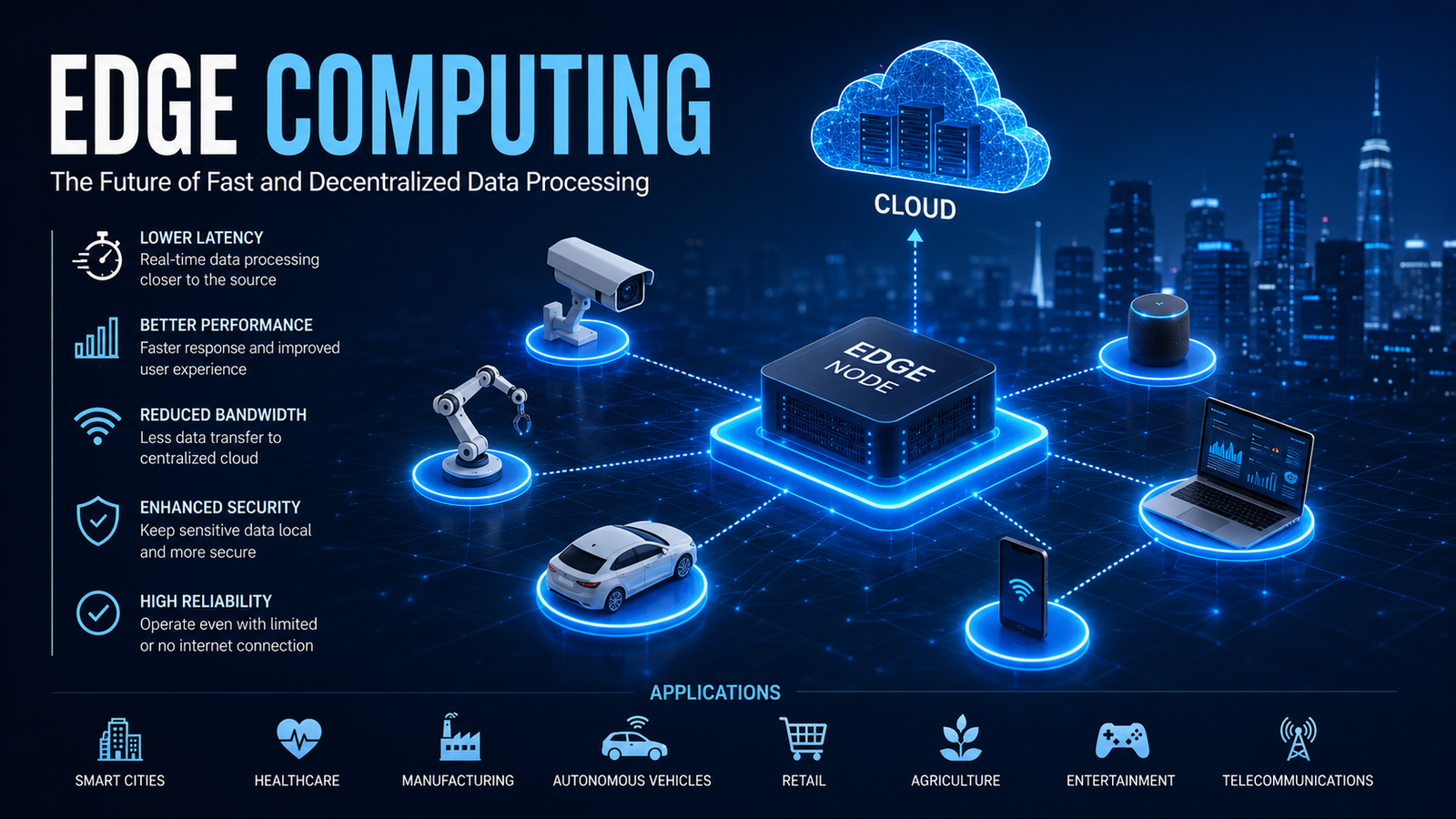
Edge Computing is transforming the way modern businesses, applications, and connected devices process and manage data. As the number of smartphones, smart devices, sensors, cameras, vehicles, and Internet of Things (IoT) systems continues to grow, organizations are producing enormous amounts of data every day. Sending all of this information to a centralized cloud server can create delays, increase network traffic, and sometimes reduce efficiency. Edge Computing provides a practical solution by bringing data processing closer to where the data is generated.
Unlike traditional cloud computing, where data is commonly sent to distant data centers for processing, Edge Computing allows information to be processed closer to users and connected devices. This approach can reduce latency, improve responsiveness, and support applications that require fast decision-making.
From smart homes and healthcare systems to autonomous vehicles, industrial automation, gaming, and telecommunications, Edge Computing is becoming an important part of modern digital infrastructure. In this article, we will explore what Edge Computing is, how it works, its benefits, applications, challenges, and why it is considered an important technology for the future.
What Is Edge Computing?
Edge Computing is a distributed computing approach that processes data closer to the location where it is generated instead of sending every piece of information to a centralized cloud or remote data center.
The “edge” refers to locations near the users, devices, sensors, machines, or other systems producing the data. Edge devices can include routers, gateways, local servers, smartphones, industrial computers, and specialized computing systems.
For example, imagine a security camera that continuously records video. With a traditional cloud-based system, the camera may send large amounts of video data to a remote server. The server then processes the information and sends a result back. With Edge Computing, an edge device can analyze the video locally and identify important events before sending only relevant information to the cloud.
This can reduce bandwidth usage and allow systems to respond more quickly.
How Does Edge Computing Work?
Edge Computing works by creating a distributed computing environment between end-user devices and centralized cloud infrastructure.
A typical Edge Computing system includes several important components. First, data-generating devices collect information through sensors, cameras, applications, machines, or connected equipment. The data can then be sent to an edge device or local computing node.
The edge device processes the information locally. Some data may be analyzed immediately, while other information can be filtered or compressed. Only the information that requires centralized storage, advanced processing, or long-term analysis may be transferred to a cloud data center.
For example, in a smart factory, sensors can monitor machines continuously. An edge computing system can analyze sensor readings locally and detect unusual activity. If a machine appears to be operating outside normal conditions, the system can quickly notify workers or trigger an automated response.
The cloud can still play an important role by storing historical information, performing large-scale analysis, training artificial intelligence models, and managing multiple edge locations.
Therefore, Edge Computing does not necessarily replace cloud computing. Instead, the two technologies can work together.
Edge Computing vs. Cloud Computing
Cloud Computing provides centralized processing and storage through remote data centers. It is extremely useful for applications that require large amounts of computing power, storage, and centralized management.
Edge Computing moves some of that processing closer to the source of the data.
One of the biggest differences is latency. When information must travel to a distant cloud server and return, communication can take longer. Edge Computing can reduce this delay by processing information locally.
Another difference is bandwidth usage. Sending huge amounts of raw data to the cloud can consume significant network resources. Edge systems can process and filter information before sending selected data to the cloud.
However, cloud computing remains valuable for large-scale processing and centralized services. A modern technology environment can therefore combine cloud and edge infrastructure to achieve better performance and flexibility.
Key Benefits of Edge Computing
1. Reduced Latency
One of the major benefits of Edge Computing is reduced latency. Applications that require fast responses can process information near the source instead of waiting for a remote server.
This is particularly important for industrial automation, connected vehicles, gaming, healthcare monitoring, and other applications where quick responses can improve performance.
2. Better Network Efficiency
Modern organizations can generate massive amounts of data. Transmitting all of this information to a centralized cloud platform can put pressure on network infrastructure.
Edge Computing can analyze, filter, and compress data locally. As a result, only necessary information needs to travel to centralized systems, potentially reducing network traffic.
3. Improved Reliability
Edge Computing can help applications continue operating even when connectivity to a centralized cloud service is limited. Local processing means that some important functions do not always depend on a constant connection to a remote server.
This can be useful in factories, remote locations, transportation systems, and other environments where network connectivity may not always be perfect.
4. Enhanced Data Privacy
Processing information closer to where it is generated can provide organizations with more control over sensitive data. Instead of transferring every piece of information to a remote server, some data can be analyzed locally.
However, Edge Computing does not automatically guarantee privacy or security. Organizations still need strong authentication, encryption, access controls, software updates, and security monitoring.
5. Scalability
Edge Computing can support large numbers of connected devices by distributing processing workloads across multiple locations.
Instead of requiring one centralized infrastructure to handle every task, organizations can deploy edge nodes in different locations. This distributed architecture can make it easier to support growing networks of devices.
Applications of Edge Computing
Edge Computing is being used or explored across many industries.
Smart Cities
Smart cities use connected sensors and devices to monitor traffic, public infrastructure, environmental conditions, energy consumption, and other services.
Edge Computing can process information locally, allowing city systems to respond more quickly to changing conditions. For example, traffic systems can analyze local traffic information and adjust signals or provide updates without sending every data point to a distant server.
Healthcare
Healthcare systems increasingly depend on connected medical devices and digital monitoring technologies. Edge Computing can help process information from devices closer to where it is collected.
For example, wearable devices can monitor various measurements and analyze information locally before sending important results to healthcare platforms.
Because healthcare data can be highly sensitive, organizations must implement appropriate security and privacy protections.
Manufacturing
Manufacturing is one of the most important areas for Edge Computing. Modern factories use sensors, robots, cameras, and connected machines to monitor production.
Edge systems can analyze machine data in real time and identify unusual patterns. This can support predictive maintenance, quality control, automation, and operational efficiency.
Autonomous and Connected Vehicles
Connected vehicles generate large amounts of data from cameras, sensors, navigation systems, and other components.
Edge Computing can help process information close to the vehicle. Fast local processing can be important for applications where decisions must be made quickly.
Retail
Retail businesses can use Edge Computing to support inventory management, customer analytics, smart shelves, security systems, and personalized services.
Local processing can reduce the amount of data that must be transferred to centralized servers and can help stores respond to information more quickly.
Gaming and Entertainment
Online gaming and interactive applications can benefit from low-latency infrastructure. Edge servers located closer to players can potentially reduce communication delays and improve responsiveness.
Streaming and other entertainment services can also use distributed infrastructure to deliver content more efficiently.
Edge Computing and Artificial Intelligence
The combination of Edge Computing and Artificial Intelligence is creating new possibilities for intelligent applications.
Artificial intelligence systems often require significant processing power. Instead of sending every piece of information to a remote cloud environment, organizations can deploy AI models directly on or near edge devices.
This approach is sometimes called edge AI. For example, a smart camera could analyze images locally and identify specific events without continuously sending the complete video stream to the cloud.
Local AI processing can reduce latency and network traffic. It can also provide additional control over data because some information can remain closer to its source.
Edge Computing and the Internet of Things
The Internet of Things is one of the strongest drivers of Edge Computing. IoT devices generate enormous amounts of information through sensors and connected systems.
If every IoT device sends all its data directly to the cloud, network requirements can become substantial. Edge Computing provides a way to process information closer to IoT devices.
For example, sensors in an agricultural environment can monitor soil conditions, temperature, humidity, and other measurements. An edge system can analyze the information locally and help determine whether a specific action is needed.
This combination of IoT and Edge Computing can support faster and more efficient connected environments.
Security Challenges of Edge Computing
Although Edge Computing offers many benefits, it also introduces security challenges.
Traditional centralized systems can be easier to manage because security controls are concentrated in fewer locations. Edge environments may contain hundreds or thousands of distributed devices, creating a larger attack surface.
Organizations must protect edge devices against unauthorized access, malware, weak passwords, outdated software, and other threats.
Security strategies can include strong authentication, encryption, secure device configuration, regular software updates, network segmentation, access controls, and continuous monitoring.
Physical security can also be important because edge devices may be installed in locations outside traditional data centers.
Challenges of Edge Computing
Security is not the only challenge. Organizations may also face deployment and management difficulties.
Managing a large number of distributed edge devices can require specialized tools and skilled professionals. Hardware costs, maintenance, software updates, monitoring, and connectivity can also increase operational complexity.
Another challenge is standardization. Different vendors may provide different hardware, software, and communication technologies. Organizations need solutions that can integrate with their existing infrastructure.
Data management is another important consideration. Companies must determine which information should be processed locally, which information should be sent to the cloud, and how long data should be stored.
The Future of Edge Computing
The future of Edge Computing looks promising as organizations continue adopting IoT, artificial intelligence, automation, 5G, and connected technologies.
As more devices become intelligent and connected, the demand for fast data processing will continue to grow. Centralized cloud infrastructure will remain important, but distributed edge infrastructure can complement it by handling time-sensitive workloads closer to users and devices.
5G networks can further support Edge Computing by providing faster connectivity and lower communication delays. Together, 5G, Edge Computing, AI, and IoT can enable new applications across transportation, manufacturing, healthcare, retail, entertainment, and smart cities.
In the coming years, businesses may increasingly adopt hybrid architectures that combine cloud, edge, and local computing. This approach can allow organizations to choose the most appropriate location for each type of workload.
See Also : Best App to Get Car Insurance Online in 2026
FAQs
What is Edge Computing?
Edge Computing is a technology that processes data closer to the device or location where the data is generated instead of sending all data to a distant cloud server.
How does Edge Computing work?
Edge Computing uses local devices, gateways, or edge servers to process and analyze data near its source. Important or selected information can then be sent to a central cloud system.
What are the main benefits of Edge Computing?
The main benefits include lower latency, faster data processing, reduced bandwidth usage, improved reliability, better control over data, and support for real-time applications.
What is the difference between Edge Computing and Cloud Computing?
Cloud Computing mainly processes data in centralized remote data centers, while Edge Computing processes some data closer to the user or data source. Both technologies can work together.
Is Edge Computing secure?
Edge Computing can provide additional control over data, but it also creates security challenges because many distributed devices need to be protected. Strong authentication, encryption, updates, and monitoring are important.
Where is Edge Computing used?
Edge Computing is used in smart cities, healthcare, manufacturing, connected vehicles, retail, gaming, telecommunications, agriculture, and Internet of Things (IoT) applications.
How is Edge Computing related to IoT?
IoT devices generate large amounts of data. Edge Computing allows that data to be processed closer to IoT devices, helping reduce network traffic and improve response times.
What is Edge AI?
Edge AI refers to running artificial intelligence models on or near edge devices. It allows some AI processing to happen locally instead of sending all information to a remote cloud server.
Does Edge Computing replace Cloud Computing?
No. Edge Computing does not necessarily replace Cloud Computing. Instead, edge and cloud systems can work together, with edge devices handling time-sensitive processing and cloud platforms providing centralized storage and large-scale computing.
What is the future of Edge Computing?
The future of Edge Computing is closely connected with AI, IoT, 5G, automation, and smart devices. As more devices generate data, local processing is expected to become increasingly important.
Conclusion
Edge Computing is changing the way organizations think about data processing. By moving computing resources closer to the source of data, it can help reduce latency, improve network efficiency, support real-time applications, and provide greater flexibility.
From smart factories and connected vehicles to healthcare, smart cities, retail, gaming, and artificial intelligence, Edge Computing has applications across many industries. At the same time, organizations must carefully address security, management, scalability, and infrastructure challenges.
As the number of connected devices continues to increase, processing every piece of information through centralized systems may not always be the most efficient approach. Edge Computing offers a distributed model that can work alongside cloud computing to create faster and more responsive digital systems.
Ultimately, Edge Computing is not simply a replacement for cloud technology. It is an important part of the broader computing ecosystem, helping organizations process data where and when it is most useful. With continued development in AI, IoT, 5G, and automation, Edge Computing is likely to remain an important technology for the future of fast and decentralized data processing.