


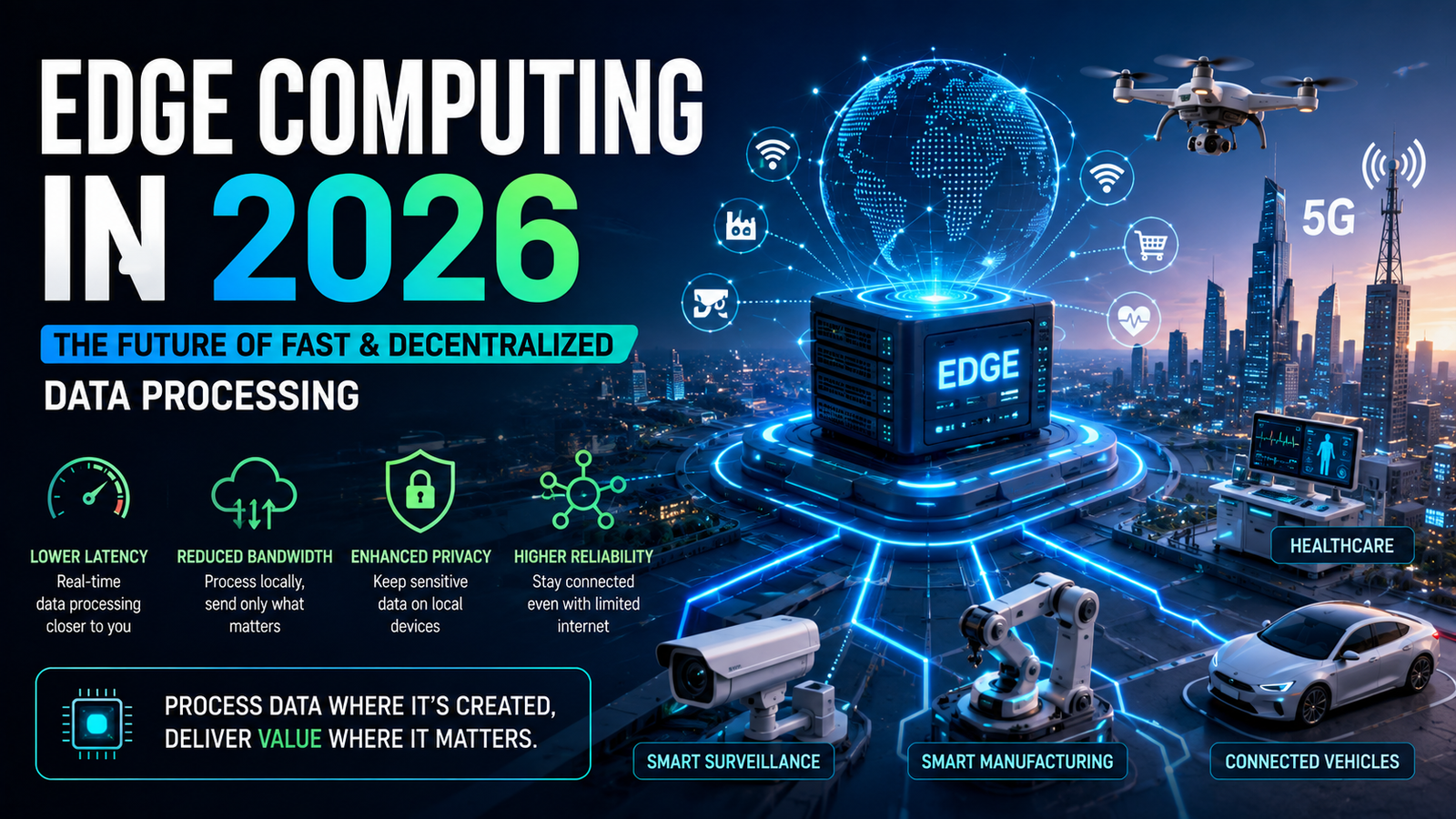
Edge Computing in 2026 is becoming an important technology for businesses, developers, organizations, and everyday digital services. As the amount of data generated by smartphones, smart devices, sensors, connected vehicles, cameras, and online applications continues to increase, traditional cloud computing alone may not always provide the speed and efficiency required by modern applications. Edge computing offers another approach by processing data closer to where it is generated.
Instead of sending every piece of information to a distant data center, edge computing allows some data processing to happen near the user or device. This can reduce delays, improve responsiveness, lower network traffic, and support applications that require fast decisions.
From smart cities and healthcare to manufacturing, gaming, transportation, artificial intelligence, and the Internet of Things, edge computing is becoming an important part of the modern digital infrastructure. In this article, we will explore what edge computing means, how it works, its benefits, applications, challenges, and why Edge Computing in 2026 is expected to play an important role in the future of digital technology.
What Is Edge Computing?
Edge computing is a distributed computing approach that processes data closer to its source instead of sending all data to a centralized cloud or data center.
For example, imagine a smart security camera monitoring a building. With a traditional cloud-based approach, the camera may send large amounts of video data to a remote server for analysis. With edge computing, an edge device or local computing system can analyze some of that information near the camera. Only important results or selected information may need to be sent to a central server.
This approach can reduce the amount of data traveling across a network and allow applications to respond more quickly.
Edge computing does not replace cloud computing. Instead, edge and cloud technologies can work together. The edge can handle tasks that require quick local processing, while the cloud can provide centralized storage, large-scale analytics, machine learning resources, and long-term data management.
How Does Edge Computing Work?
The basic concept behind edge computing is relatively simple. Data is generated by a device, sensor, application, or user. Instead of automatically sending everything to a remote data center, some of the processing happens closer to the source.
An edge environment can include different types of hardware, such as local servers, gateways, routers, industrial computers, smart devices, or specialized edge systems.
A typical process may look like this:
- A device generates data.
- The data is transferred to a nearby edge system.
- The edge system processes or analyzes the information.
- Immediate decisions can be made locally.
- Important information can be sent to a central cloud system for additional processing or storage.
This distributed model can be especially useful when applications need fast responses.
Why Edge Computing Matters in 2026
The growth of connected devices is one of the major reasons edge computing is becoming increasingly important. Businesses and consumers are generating enormous amounts of digital information every day.
Smart cameras, industrial sensors, connected vehicles, wearable devices, smart appliances, and other Internet of Things technologies continuously produce data.
Sending all of this information to centralized cloud servers can create additional network traffic and may increase response times. Edge Computing in 2026 addresses this challenge by bringing processing resources closer to data sources.
Another important factor is the growing use of artificial intelligence. AI applications can require rapid processing of large amounts of data. Running certain AI tasks closer to where the data is created can help reduce delays and improve responsiveness.
Edge Computing and Cloud Computing
Edge computing and cloud computing are often discussed together because they solve different parts of the same problem.
Cloud computing provides powerful centralized resources. It is useful for large-scale data storage, advanced analytics, application hosting, backups, and complex computing tasks.
Edge computing focuses on local processing and fast responses.
A modern organization may use both. For example, an industrial company could use edge systems to monitor machines in real time while sending selected information to the cloud for long-term analysis.
This combination can create a flexible technology environment where data is processed in the most suitable location.
Benefits of Edge Computing
Lower Latency
Latency refers to the delay between sending data and receiving a response. When data travels to a distant server and back, additional network delay can occur.
Processing information closer to the source can reduce this delay. This is valuable for applications where fast responses are important.
Reduced Network Traffic
Edge computing can process or filter data locally before sending it to the cloud. This can reduce the amount of information that needs to travel across a network.
For organizations handling large volumes of data, reducing unnecessary network traffic can improve efficiency.
Better Real-Time Performance
Applications such as industrial monitoring, smart transportation, robotics, and interactive systems may need quick decisions.
Local processing can help these systems respond faster because they do not always need to wait for a remote server.
Improved Reliability
Edge systems can continue performing certain tasks locally even when connectivity to a central cloud service is limited or temporarily unavailable.
This can be useful in remote locations, industrial environments, and other situations where network reliability is important.
Greater Data Control
Processing sensitive information closer to where it is generated can provide organizations with additional options for managing data.
However, edge computing does not automatically guarantee privacy or security. Proper security controls are still necessary.
Edge Computing and Artificial Intelligence
Artificial intelligence is one of the areas where edge computing can provide significant benefits.
Traditional AI applications may send data to centralized servers for processing. With edge AI, certain AI models can run directly on or near devices.
For example, a smart camera could identify specific events locally rather than continuously uploading every frame of video to a remote server.
Edge AI can reduce latency and network usage while allowing faster responses.
In Edge Computing in 2026, the combination of AI and edge processing is expected to remain important as businesses look for ways to deploy intelligent applications closer to users and devices.
Edge Computing in Smart Cities
Smart cities use connected technologies to monitor traffic, energy consumption, public services, environmental conditions, and other urban systems.
Edge computing can help process information locally.
For example, traffic-management systems can analyze information from sensors and cameras to help identify changing traffic conditions. Local processing can support faster responses without requiring every piece of information to travel to a distant data center.
Edge technology can also support smart lighting, parking systems, environmental monitoring, and other connected services.
Edge Computing in Healthcare
Healthcare is another area where fast and reliable data processing can be valuable.
Connected medical devices and monitoring systems can generate large amounts of information. Edge computing can help process certain data closer to the device.
For example, a monitoring system may analyze incoming information locally and identify conditions that require attention. The appropriate information can then be transmitted to centralized systems.
Healthcare organizations still need strong privacy, security, compliance, and data-management practices when using edge technologies.
Edge Computing in Manufacturing
Manufacturing facilities increasingly use sensors, connected machines, robotics, and automated systems.
These devices can generate large volumes of data. Edge computing can process information locally and help manufacturing systems respond quickly.
For example, an edge system could analyze machine data and identify unusual operating patterns. This may help organizations detect potential equipment problems earlier and improve maintenance planning.
Local processing can also support industrial automation where fast responses are important.
Edge Computing in Transportation
Connected vehicles and transportation systems can generate information about locations, road conditions, vehicle performance, and surrounding environments.
Edge computing can support faster processing in transportation environments.
Autonomous and assisted-driving technologies, traffic management, fleet monitoring, and connected transportation systems can benefit from processing information closer to where it is generated.
Because transportation applications can involve safety-related decisions, reliability, security, testing, and regulatory requirements are particularly important.
Edge Computing for Gaming and Entertainment
Gaming and interactive digital services can also benefit from low-latency computing.
Cloud gaming relies on remote computing resources, but the distance between the user and server can influence responsiveness.
Edge infrastructure located closer to users can potentially reduce network delays and improve the experience of latency-sensitive applications.
Similarly, augmented reality and virtual reality applications can benefit from fast processing because delays can negatively affect interactive experiences.
Security Challenges of Edge Computing
Although edge computing offers many benefits, it also introduces security challenges.
Traditional centralized systems can concentrate security management in a smaller number of locations. Edge environments may contain many distributed devices and servers.
Each device can potentially become a security target.
Organizations therefore need strong authentication, encryption, software updates, access controls, monitoring, and device-management policies.
Physical security can also matter because edge devices may be installed outside traditional data centers.
Privacy Considerations
Edge computing can support privacy-conscious architectures because some information can be processed locally instead of being sent elsewhere.
For example, a system may analyze data locally and send only the necessary results to a central server.
However, privacy depends on how the entire system is designed. Organizations still need to determine what information is collected, how it is processed, where it is stored, and who can access it.
Challenges of Edge Computing
Edge computing is not a perfect solution for every application.
Managing many distributed devices can be complicated. Organizations may need specialized hardware, software, monitoring systems, and technical expertise.
Maintenance can also become more difficult when devices are located across different physical locations.
Security is another major challenge because every connected edge device can potentially increase the system’s attack surface.
Cost is also a consideration. Deploying and maintaining edge infrastructure requires investment, especially for large organizations.
The Future of Edge Computing
The future of edge computing is closely connected to the growth of AI, IoT, automation, 5G and other advanced connectivity technologies.
As more devices become connected and intelligent, organizations will need efficient ways to process data.
Future edge systems may become more automated, flexible, and capable of running advanced AI workloads locally.
Cloud and edge environments are also likely to become increasingly integrated. Instead of choosing between cloud and edge computing, organizations can distribute workloads between both environments based on performance, cost, security, and business requirements.
How Businesses Can Prepare for Edge Computing
Businesses interested in edge technology should begin by identifying applications where local processing could provide a clear benefit.
They should evaluate latency requirements, data volumes, security needs, connectivity conditions, hardware requirements, and expected costs.
Starting with a small project can help an organization understand the technology before expanding it across a larger environment.
Businesses should also invest in monitoring, security, device management, and employee training.
Conclusion
Edge Computing in 2026 represents an important development in the way digital information is processed. By moving computing resources closer to data sources, edge technology can reduce latency, decrease network traffic, support real-time applications, and improve the efficiency of connected systems.
Edge computing is already relevant across industries such as manufacturing, healthcare, transportation, smart cities, entertainment, and artificial intelligence. Its importance is likely to grow as organizations connect more devices and demand faster digital experiences.
However, edge computing also comes with challenges, including security, privacy, device management, maintenance, and infrastructure costs. Organizations should therefore adopt it strategically rather than treating it as a replacement for every existing technology.
The most effective future may involve a combination of edge computing and cloud computing. Edge systems can handle time-sensitive local processing, while cloud platforms can provide centralized storage, advanced analytics, and large-scale computing.
As digital technology continues to evolve, Edge Computing in 2026 is helping create a more distributed, responsive, and intelligent computing environment. For businesses and technology professionals, understanding edge computing today can be valuable for preparing for the increasingly connected digital world of tomorrow.
See Also : Best App to Get Car Insurance Online in 2026
FAQs
What is Edge Computing in 2026?
Edge Computing in 2026 refers to processing data closer to where it is generated instead of sending all information to a distant cloud or centralized data center.
What are the main benefits of edge computing?
The main benefits include lower latency, reduced network traffic, faster responses, improved local processing, and greater flexibility for connected applications.
Is edge computing replacing cloud computing?
No. Edge computing and cloud computing can work together. Edge systems handle local and time-sensitive tasks, while cloud platforms can provide centralized storage and large-scale computing.
Is edge computing replacing cloud computing?
No. Edge computing and cloud computing can work together. Edge systems handle local and time-sensitive tasks, while cloud platforms can provide centralized storage and large-scale computing.
How does edge computing support AI?
Edge computing can allow certain AI models and workloads to run closer to the data source, helping reduce delays and network traffic for applications that require fast responses.
Where is edge computing used?
Edge computing can be used in smart cities, manufacturing, healthcare, transportation, retail, telecommunications, gaming, security systems, and Internet of Things applications.
Is edge computing secure?
Edge computing can be secure when properly designed, but distributed systems introduce additional security challenges. Strong authentication, encryption, updates, monitoring, and access controls are important.
Why is edge computing important for IoT?
IoT devices can generate huge amounts of data. Edge computing can process some of that information locally, reducing the amount of data that must be transferred to centralized cloud systems.
What is the future of edge computing?
The future of edge computing is expected to involve greater integration with artificial intelligence, IoT, advanced connectivity, automation, and cloud platforms, creating faster and more distributed digital systems.